Home → Concepts
Concepts
The observation framework.
Wireless context
The term wireless context is used to describe factors that affect the performance of a wireless network. These are typically focused on signal strength, interference, and the user mobility that the network allows.
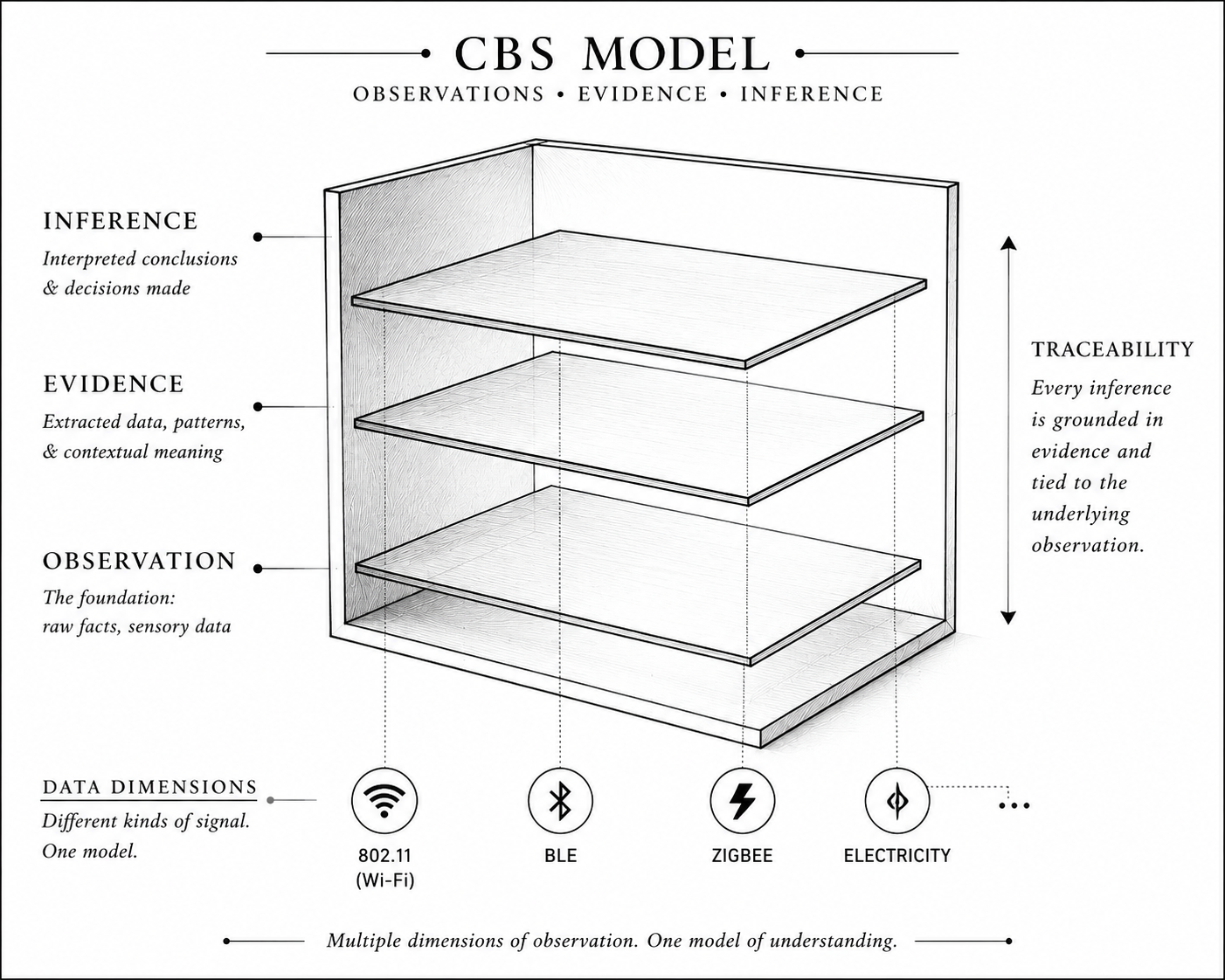
Context By Signal℠ envisions wireless context as the real world environment of the network user. Wireless context is the totality of the wireless environment, encompassing nearby networks, access points, and devices within range of the receiver. We acknowledge the impacts of concurrent dimensions of use that cut across and increasingly converge with WiFi networks—for example, IoT and residential electrical systems. We envision a wireless context that is site-specific, and sites with behavioral surfaces marked by persistence and travel.
Wireless context awareness
Wireless services are not isolate. They can't be contained in cables and they don't stop at the front door. Signal is diffuse and variable. WiFi networks mix and move. They conflict and contend. Wireless networks offer great convenience and, with that, great vulnerability.
- Signal is the electromagnetic wave that is radio.
- Spectrum is signal's spread across frequency.
- WiFi spectrum travels on the 2.4 GHz and 5 GHz bands.
- Wireless context is the environment and conditions that affect wireless communication, including signal strength, interference, and mobility.
Wireless services lack transparency. This makes it hard to understand the wireless environment around us. Context works against opacity.